
Part 1 Questions
- Do you like to keep things tidy?
- Did you use to keep your room tidy as a child?
- How do you keep your work or study space tidy?
- Do you think that it is necessary to be tidy?
Practice status: Archived topic from a previous question-bank cycle. It remains useful for skill practice but is not presented as a current or guaranteed exam question. How topics are labelled.
Read the complete transcript
Generally I prefer to keep things tidy. I find that having a clear space helps me think and means I don't waste time looking for things. That said, I'm not obsessive about it — if I'm very busy I might let things pile up for a day or two, then I set aside time to sort everything out.
See the topic before you speak
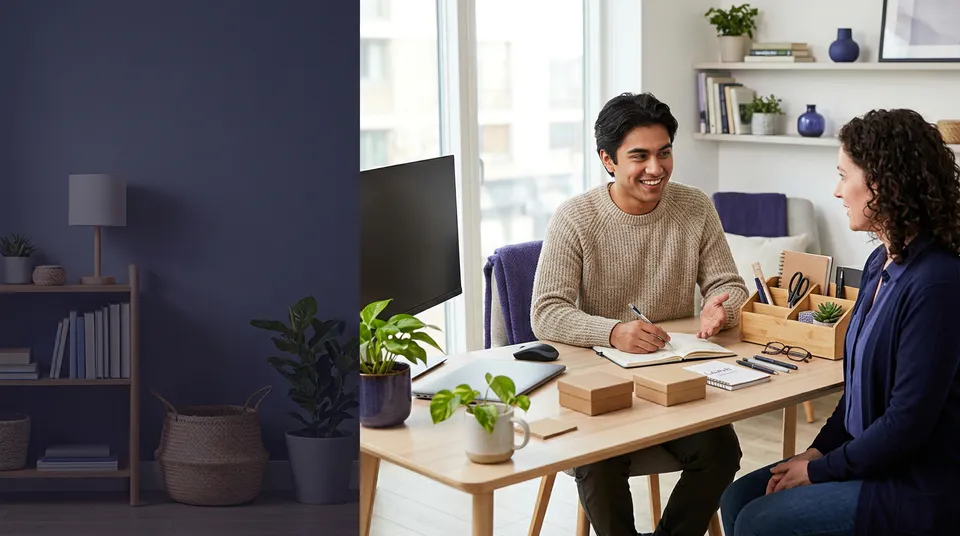
Use the images as idea prompts. Describe what you notice, connect it to your experience, then answer the real question.

Model answers, heard side by side
Start with the simpler answer, switch bands to hear how the same task can be developed, then record a personal response. These are teaching examples, not official answers or score guarantees.
Do you like to keep things tidy?
Yes, I do. I like things to be tidy because it makes it easier to find things. When my flat is tidy I feel calmer and less stressed. Sometimes I leave a bit of mess if I'm busy, but I usually do a quick tidy-up.
Generally I prefer to keep things tidy. I find that having a clear space helps me think and means I don't waste time looking for things. That said, I'm not obsessive about it — if I'm very busy I might let things pile up for a day or two, then I set aside time to sort everything out.
Did you use to keep your room tidy as a child?
No, not really. As a child I often left toys on the floor and my room could be messy. My parents had to tell me to clean it sometimes. Every so often I would tidy it properly.
I wasn't particularly tidy as a young child — my room could be a bit of a mess with toys and books everywhere. As I got older, especially at secondary school, I started to keep things neater because my parents insisted and I realised it made studying easier. So it improved with age and habit.
How do you keep your work or study space tidy?
I try to keep my desk tidy by putting pens and papers back in drawers. I clear away cups and food, and I throw away rubbish. If I finish work I make sure the desk is ready for the next day.
I keep my study space tidy by doing a quick clear-up at the end of each day: I file loose papers into labelled folders, stash chargers and cables in a box, and wipe the surface. I also do a more thorough declutter at the weekend so old notes don't build up. It really helps me stay focused.
Do you think that it is necessary to be tidy?
Yes, I think it is necessary to be tidy to some extent. Being tidy helps you work better and keeps things clean. But I don't think you need to be perfect all the time; a bit of mess is OK.
I think being reasonably tidy is important because it boosts productivity and reduces stress — you're less likely to lose things and more likely to concentrate. However, there's also room for personal style: some people do their best work in a bit of creative chaos, so it's not absolute. The key is finding a balance that works for you.
Practice status: Archived topic from a previous question-bank cycle. It remains useful for skill practice but is not presented as a current or guaranteed exam question. How topics are labelled.
How to answer Tidiness IELTS Speaking questions
This Tidiness set contains 4 short interview questions. Start each answer with the information the examiner asked for, then extend it with one reason, example or contrast. The goal is spontaneous, connected speech—not a mini-essay.
- Answer the exact question in the first sentence.
- Add one reason or specific personal detail.
- Use an example or contrast only when it adds new information.
- Finish naturally and let the examiner ask the next question.
Question-by-question approach
| Practice question | Useful answer move |
|---|---|
| Do you like to keep things tidy? | Answer directly, give a reason and add one natural personal detail. |
| Did you use to keep your room tidy as a child? | Give a real past example, then say what changed or why it mattered. |
| How do you keep your work or study space tidy? | Describe the process or difference in a clear order and add a result. |
| Do you think that it is necessary to be tidy? | State a likely view, explain the reason and add one condition or example. |
Vocabulary focus
Useful language already demonstrated in the model answers includes tidy up, on top of things, clutter, a bit of a mess, insisted, habit, labelled folders, declutter. Learn each meaning and a natural word partnership, then use the item in a fresh answer instead of copying a complete script.
Common mistakes to avoid
- Giving a memorised response that only partly answers the question.
- Adding difficult vocabulary without checking meaning or collocation.
- Restarting after every error instead of correcting briefly and continuing.
- Reading the model answer before recording your own first attempt.
Tidiness practice FAQ
How long should my answer be for Tidiness in Part 1?
Aim for a direct answer plus a reason or detail, usually two to four sentences. Stop when the idea is complete rather than forcing a fixed word count.
Should I memorise the Tidiness model answers?
No. Use them to notice structure and language, then answer from your own experience. Memorised wording can fail when the examiner changes the question.
What if I have no experience of the topic?
Say that honestly, then explain a related preference, observation or hypothetical example. You are assessed on language, not specialist knowledge.